How to Label Moving Boxes So Unpacking Is Easy
The move is only half the job. The other half starts when the truck pulls away and you are standing in a new place surrounded by identical brown boxes. If every one of them just says “misc,” you are in for a long weekend of guessing. Good labeling is the difference between finding your coffee maker in ten seconds and tearing open six boxes to get to it.
We have loaded and unloaded more than a thousand moves, and the people who unpack fastest almost always have one thing in common. They decided on a labeling system before the first box got taped shut. Here is the approach we recommend, from the first roll of tape to the last box off the truck.
Start with a plan, not a marker
The most common mistake is grabbing a marker and writing whatever pops into your head on the nearest flap. Do that across 40 boxes and you end up with 40 labels that make sense to nobody, including you.
Before you pack anything, decide that every box will carry the same three pieces of information: which room it belongs in, roughly what is inside, and how soon you will need it. Lock in those three and labeling becomes fast and consistent, and the boxes basically sort themselves on the other end.
Color-code by room
Color is the fastest thing the human eye reads, faster than any word you can write. Assign each room a color and mark every box with it, using colored tape, colored dots, or a set of colored markers.
| Room | Color | Example label |
|---|---|---|
| Kitchen | Red | KITCHEN: pots & pans (Week 1) |
| Primary bedroom | Blue | BEDROOM: bedding (Open First) |
| Bathroom | Green | BATH: towels, toiletries (Week 1) |
| Living room | Yellow | LIVING: books, decor (Later) |
| Kids / guest room | Orange | KIDS: toys, clothes (Week 1) |
| Garage / storage | Black | GARAGE: tools (Later) |
Here is the trick that makes color pay off. Tape a matching colored card on the door of each room at your new place before moving day. Now anyone carrying a red box knows it goes to the kitchen without asking, which keeps a crew moving and keeps you from playing traffic cop all day.
Write the four things that matter
A color tells the room. A short written label handles the rest. On each box, keep it to four quick notes:
- The room, spelled out (KITCHEN, not just red).
- Two or three main contents so you can find things without opening it (plates, mugs, small appliances).
- A priority level, like “Open First,” “Week 1,” or “Later.” This alone saves you hours.
- Handling notes if they apply, such as FRAGILE or THIS SIDE UP.
Resist the urge to inventory every single item. You do not need “8 dinner plates, 4 bowls, 1 gravy boat.” A few words that jog your memory is the sweet spot.
Label the sides, not just the top
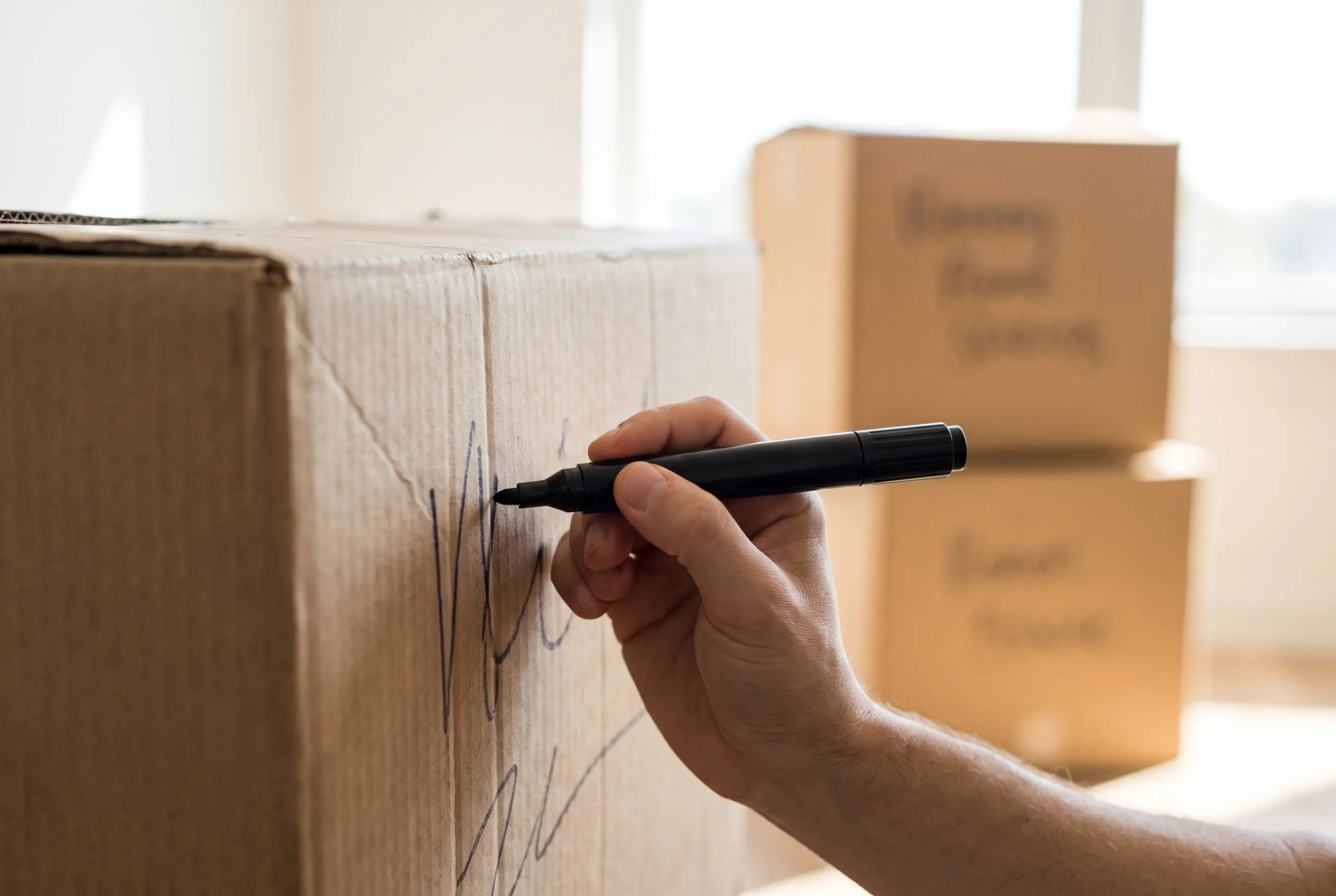
This is the tip people wish they had known sooner. Once boxes are stacked, you cannot see the tops. Write your label on at least two sides so you can read it no matter how the stack is arranged, and you will never have to unstack a wall of cartons just to find out what is on top.
Number your boxes and keep a master list
Give each box a number within its room, like “Kitchen 4 of 9.” Then jot a one-line note next to that number on a list you keep on your phone or in a notebook.
It takes about five seconds per box, and what you get back is worth far more:
- You instantly know if anything did not make it. If you have Kitchen 1 through 8 but no 9, you look for one specific box instead of panicking about everything.
- If you ever need to file a claim, an itemized list is exactly what an insurer wants to see.
- You can tell helpers “grab boxes 1 through 4 first” and trust they will get the right ones.
Build an “Open First” box
Pack one box (or one per person) with the things you will want within the first hour, before you have unpacked anything else. Think toilet paper, hand soap, phone chargers, any medications, coffee and a mug, snacks, a box cutter, paper towels, a change of clothes, and sheets for the bed. Label it in bright, obvious lettering and load it onto the truck last so it comes off first. That single box is the reason your first night in a new home feels manageable instead of chaotic. For more on setting up that first day, our moving day tips guide walks through the whole rhythm of the day.
Handle the fragile and awkward stuff
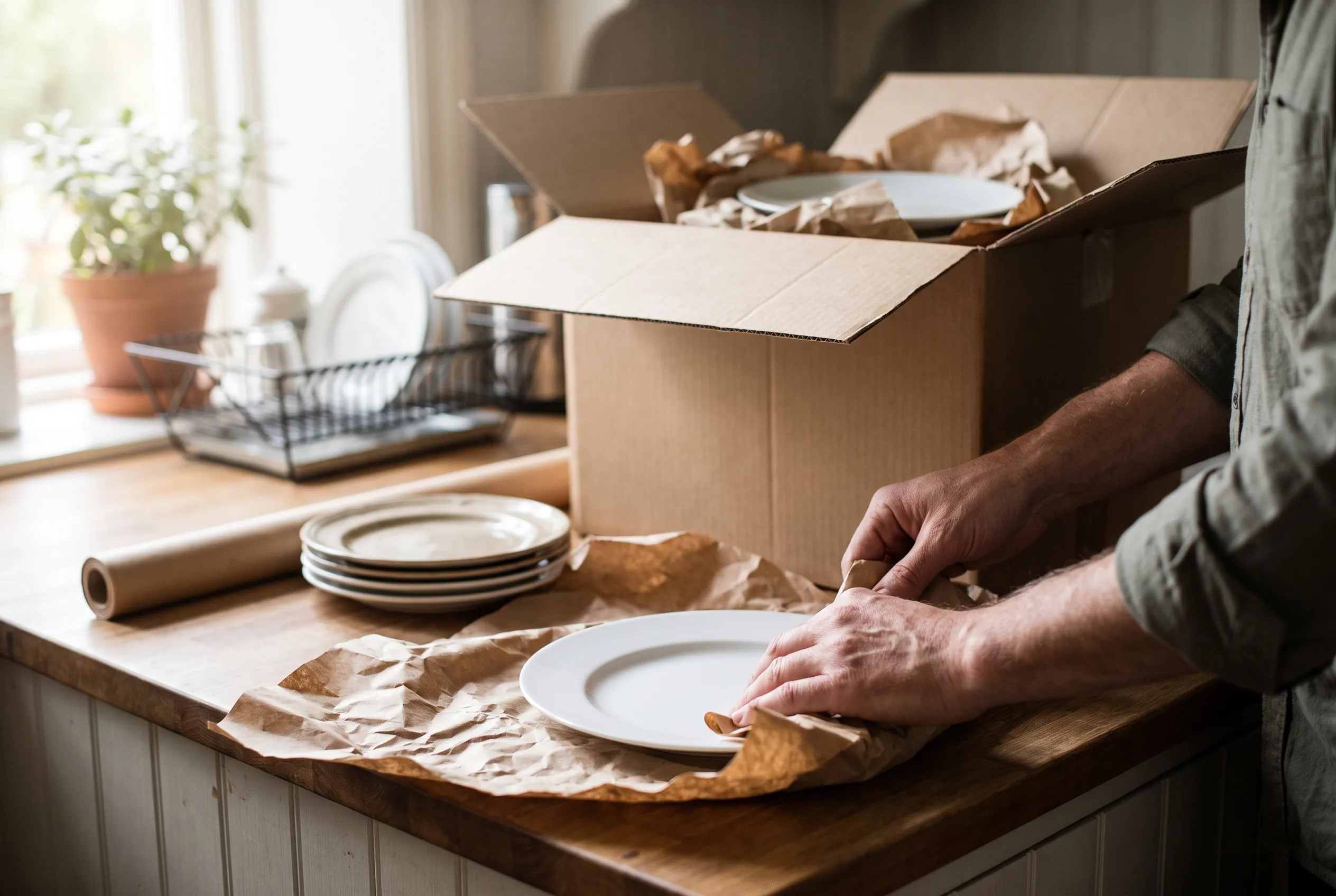
Fragile boxes deserve their own clear marking on every side, not a small note buried in a corner. Write FRAGILE and THIS SIDE UP in large letters, and mean it. Pack plates on their edges rather than stacked flat, cushion glassware, and fill empty space so nothing shifts. The kitchen is usually the trickiest room in the house, so if that one has you stumped, our step-by-step guide to packing a kitchen covers dishes, glasses, and small appliances in detail.
Some items should never go in a labeled box at all. Pianos, safes, antiques, and heirloom furniture need blankets, straps, and a plan, the kind of careful handling we build into every job.
Go digital if you like
If you want to lean on your phone, a simple spreadsheet or notes app works fine. Some people snap a photo of the open box before they seal it and note the box number, so the picture becomes their inventory. QR-code labeling apps exist too. Just do not let the app become another chore. A marker and a roll of colored tape still beat a half-finished system in an app you stopped updating halfway through packing.
A few Spokane-specific notes
A move here comes with its own quirks worth planning for.
- Multi-level homes. Plenty of houses on the South Hill have basements and second floors. Note the floor on the label (“BASEMENT: holiday decor”) so nothing gets carried up two flights only to come back down.
- Winter moves. Cold, damp cardboard makes marker ink smear. Write labels before boxes sit in a chilly garage, or use printed labels under clear tape so they stay readable.
- Apartments and walk-ups. In a building with stairs or a shared elevator, a clear priority label lets the crew stage the essentials near the door and leave the “Later” boxes for last.
If your movers are packing for you
When we handle the packing, we inventory and label as we go, so you are not stuck doing it yourself the week before. The one thing that helps us most is knowing your priorities. Tell us which room you want unpacked first and what belongs in your “Open First” box, and we will label accordingly. You can see how that fits into the bigger picture on our packing services page, and if you are moving anywhere around Spokane Valley, we know the neighborhoods and the buildings.
The quick version
- Decide on your system before you pack: room, contents, priority on every box.
- Color-code by room and put matching color cards on the doors at the new place.
- Write labels on the sides, not just the top, so you can read stacked boxes.
- Number boxes and keep a simple master list so nothing goes missing.
- Pack one clearly marked “Open First” box and load it last.
- Mark fragile boxes boldly on every side.
A little effort with a marker and some colored tape turns unpacking from a scavenger hunt into a smooth, room-by-room process. If you would rather hand the whole thing off, we pack, label, and move with a dedicated truck and the same crew from start to finish. For a clear, upfront price with no hidden fees, reach out for a free quote or call us at (509) 862-4968. And if you are still early in your planning, our ultimate moving checklist is a good next stop.
Planning a move in the Spokane area?
Get a free, no-obligation quote from a licensed local crew.