How to Move a Piano Without Wrecking It (or Your Back)
A piano looks like furniture. That is the trap. A three-seat couch and an upright piano take up about the same floor space, so people assume they move about the same way. Then four friends get their hands under it, lift, and discover they are holding six hundred pounds that is heavier at the top than the bottom and wants to tip the second someone loses their grip. That is the moment most piano damage, and most back injuries, actually happen.
We move pianos on a regular basis around Spokane, and a piano is very movable when you respect what it is. Here is what makes it hard, and how a trained crew gets one down a flight of stairs and across town without a scratch on the instrument or the house.
Why a piano is so much harder than it looks
Three things set a piano apart from anything else in your home.
First is the weight, and how it hides. A small spinet can run around 300 pounds. A full upright often lands between 500 and 800. A grand can pass 1,000. None of that weight is spread evenly. Most of it sits high and toward the back, which is why a piano tips so easily and why lifting it wrong puts every ounce onto your lower spine.
Second is what is inside. A cast iron plate, the big gold frame you see when you lift the lid, holds the strings under enormous tension, roughly twenty tons of pull across the whole instrument. That plate is strong, but it is also a lot of the reason a piano is so dense and so intolerant of being dropped or racked at an angle.
Third are the casters. The little wheels on the bottom of most pianos are made for nudging the instrument a few inches to dust behind it, not for rolling it across a room or over a threshold. Push a heavy piano any real distance on its own casters and you risk snapping one off, gouging your floors, or setting the whole thing off balance.
Uprights and grands are two different jobs
People lump all pianos together, but moving an upright and moving a grand are not the same task.
| Upright piano | Grand piano | |
|---|---|---|
| Typical weight | 300 to 800 lbs | 500 to over 1,000 lbs |
| How it travels | Stays upright, blanket-wrapped, strapped to a four-wheel dolly | Legs and pedal lyre come off, body tilts onto a padded skid board |
| Biggest risk | Tipping forward, top-heavy | Damaging the legs, lyre, and finished rim |
| People needed | 3 to 4 | 3 to 4, plus a lead calling the lift |
An upright stays vertical the entire time. A grand is different. You cannot roll a grand on its own three legs, because those legs are not built to carry the body sideways or over a bump. So a grand gets partly taken apart. The crew removes the legs and the lyre (the pedal assembly), lays the body carefully onto its long straight side on a padded board called a skid board, then straps it down and stands the board up to roll it. Done right it is smooth. Done wrong you crack a leg or crush the lyre, and those repairs are expensive.
The gear that makes it safe
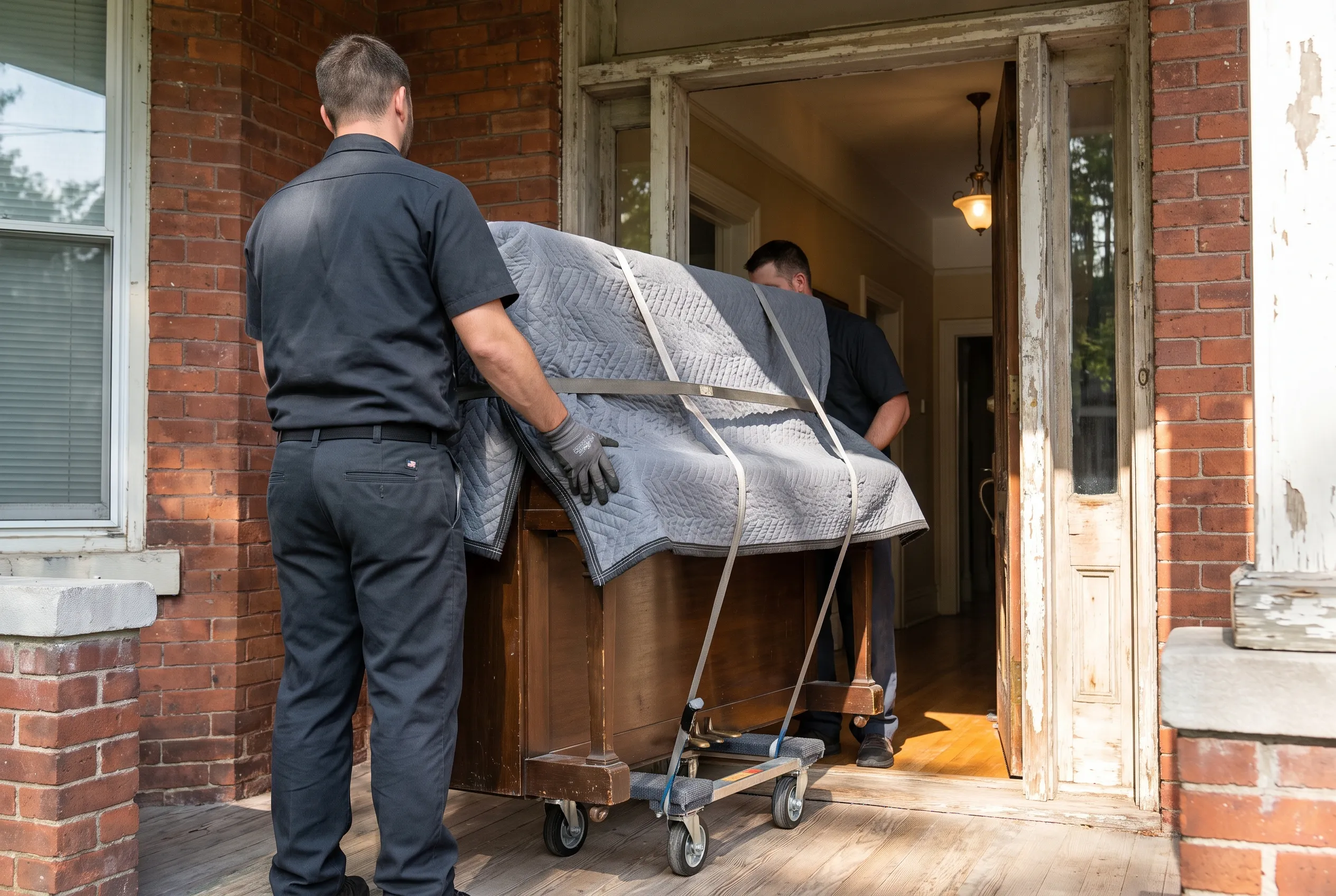
Muscle is not the answer to a piano. Leverage and the right equipment are. A real piano move uses:
- A four-wheel piano dolly rated for the weight, so nobody carries the load across flat ground.
- A skid board and heavy ratchet straps for grands, and for uprights on stairs.
- Thick moving blankets to wrap every surface, plus stretch wrap or tape to hold them.
- Ramps for porch steps and the truck, so the piano rolls instead of getting lifted repeatedly.
- Enough hands, with one person whose only job is to call each move so the crew lifts and pivots at the same time.
None of that is exotic, but most households do not have a piano dolly and a skid board in the garage, and improvising with a furniture dolly and bath towels is how pianos end up on their side in a stairwell.
The stairs are where pianos are lost
Flat ground is the easy part. Stairs, porches, and tight doorways are where a move goes wrong. The rule our crews follow is simple: on stairs, the piano never gets above you. The people below control the weight and set the pace, and the piano moves one measured step at a time, never in a rush.
This matters a lot in Spokane. Plenty of the homes we work in, especially the older places on the South Hill and around Browne’s Addition, have a piano sitting in a finished basement at the bottom of a narrow, turning staircase, or up on a raised front porch. In winter those same porch steps get icy. Before we touch the piano we measure every doorway, hallway, and turn, and we plan the exact path out so there are no surprises with the instrument already in the air. If you want a sense of what separates a real crew from a risky one, our guide on how to choose a licensed mover covers the questions worth asking.
Protect the house, not just the piano
A dropped piano is the disaster everyone pictures. The quieter damage is to the home. A piano cornering through a doorway can crack door casings, dent drywall, and scrape hardwood. We pad the instrument first, then protect the route: door jambs get covered, floors get runners, and tight corners get an extra set of eyes. The same careful-handling habits apply to any heavy, awkward, or irreplaceable item, which is the same mindset behind packing fragile items so nothing shifts in transit.
After the move: give it time, then tune it
Here is the part people forget. A piano almost always needs tuning after it moves, and the move itself is only part of the reason. The bigger factor is the new room. Different humidity and temperature change the tension in the strings and the wood as they settle. Because of that, most technicians suggest waiting two to four weeks after the move, letting the piano acclimate to its new home, and then tuning it. Tuning the day it arrives usually means paying to do it again a month later.
When to call a crew
If your piano only moves across one level, with three strong and careful people and a proper dolly, you may be fine handling it yourself. The moment stairs, tight turns, a grand, or a genuinely valuable instrument enter the picture, the math changes fast. One slip can mean a hospital visit, a ruined floor, or damage to a piano that cost more than the entire move.
That is the work we do. Our piano and specialty moving service brings the dolly, the skid board, the blankets, and a crew that has done this many times, and your piano rides on your own dedicated truck, never mixed with another household’s load. We handle pianos across Spokane and the surrounding area, from the Valley to Coeur d’Alene.
If you have a move coming up and a piano in the middle of it, reach out for a free quote or call us at (509) 862-4968. We are glad to walk through your stairs and doorways and tell you honestly what it will take.
Planning a move in the Spokane area?
Get a free, no-obligation quote from a licensed local crew.